TRIZ
A powerful methodology for creative problem-solvingBy Katie Barry, Ellen Domb and Michael S Slocum
Projects of all kinds frequently reach a point where as much analysis as possible has been carried out, but the way forward is still unclear. Progress seems blocked, and if the project team is to move forward, it must develop creative solutions to the problems it faces.
You’ll already know about techniques such as brainstorming, which can help with this sort of situation. However, this type of approach, which depends on intuition and the knowledge of the members of the team, tends to have unpredictable and unrepeatable results. What’s more, a huge range of possible solutions can be missed, simply because they’re outside the experience of the project team.
TRIZ is a problem solving methodology based on logic, data and research, not intuition. It draws on the past knowledge and ingenuity of many thousands of engineers to accelerate the project team’s ability to solve problems creatively. As such, TRIZ brings repeatability, predictability, and reliability to the problem-solving process with its structured and algorithmic approach.
About TRIZ
“TRIZ” is the (Russian) acronym for the “Theory of Inventive Problem Solving.” G.S. Altshuller and his colleagues in the former USSR developed the method between 1946 and 1985. TRIZ is an international science of creativity that relies on the study of the patterns of problems and solutions, not on the spontaneous and intuitive creativity of individuals or groups. More than three million patents have been analyzed to discover the patterns that predict breakthrough solutions to problems, and these have been codified within TRIZ.
“TRIZ” is the (Russian) acronym for the “Theory of Inventive Problem Solving.” G.S. Altshuller and his colleagues in the former USSR developed the method between 1946 and 1985. TRIZ is an international science of creativity that relies on the study of the patterns of problems and solutions, not on the spontaneous and intuitive creativity of individuals or groups. More than three million patents have been analyzed to discover the patterns that predict breakthrough solutions to problems, and these have been codified within TRIZ.
TRIZ is spreading into corporate use across several parallel paths - it is increasingly common in Six Sigma processes, in project management and risk management systems, and in organizational innovation initiatives.
Generalized Solutions
TRIZ research began with the hypothesis that there are universal principles of creativity that are the basis for creative innovations, and that advance technology. The idea was that if these principles could be identified and codified, they could be taught to people to make the process of creativity more predictable. The short version of this is:
Somebody someplace has already solved this problem (or one very similar to it.) Today, creativity involves finding that solution and adapting it to this particular problem.
The three primary findings of the last 65 years of research are as follows:
1.> Problems and solutions are repeated across industries and sciences. By classifying the “
"contradictions” (see later) in each problem, you can predict good creative solutions to that
problem.
2.> Patterns of technical evolution tend to be repeated across industries and sciences.
3.> Creative innovations often use scientific effects outside the field where they were developed.
Much of the practice of TRIZ consists of learning these repeating patterns of problems-solutions, patterns of technical evolution and methods of using scientific effects, and then applying the general TRIZ patterns to the specific situation that confronts the developer. Figure 1, below, describes this process graphically.
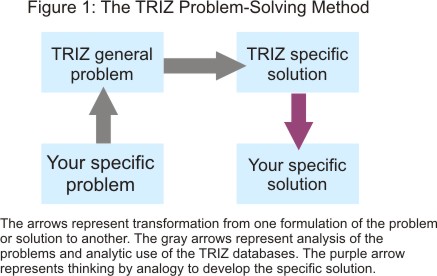
Here, you take the specific problem you face, and generalize it to one of the TRIZ general problems. From the TRIZ general problems, you identify the TRIZ solutions to those general problems, and then see how these can be applied to the specific problem you face.
Example
A powerful demonstration of this method was seen in the pharmaceutical industry. Following the flow of Figure 1, the specific problem was as follows: an important process needed cell walls to be broken down in bacteria cells so that hormones inside the cells could be harvested. A mechanical method for breaking the cell walls had been in use at a moderate scale for some time, but the yield was only 80%, and was variable. Higher yields and a scaleable solution were needed.
The TRIZ general problem at the highest level is to find a way to produce the product with no waste, at 100% yield, with no added complexity. One of the patterns of evolution of technology that TRIZ identifies is that energy (fields) replaces objects (mechanical devices). For example, consider using a laser instead of a scalpel for eye surgery. In this case, ultrasound could be used to break the cell walls, or an enzyme could be used to “eat” it (chemical energy). This may seem very general, but it led the pharmaceutical researchers to analyze all the resources available in the problem (the cells, the cell walls, the fluid they are in, the motion of the fluid, the processing facility, etc.) and to conclude that three possible solutions had a good potential for solving their problem:
->The cell walls could be broken by sound waves (from the pattern of evolution of replacing
mechanical means by fields).
-> The cell walls could be broken by shearing, as they pass through the processing facility (using
the resources of the existing system in a different way).
-> An enzyme in the fluid could “eat” the cell walls and release the contents at the desired time.
All three methods have been tested successfully. The least expensive, highest yield method was soon put in production.
Eliminating contradictions
Another of the fundamental concepts behind TRIZ is that at the root of many problems is a fundamental contradiction that causes it (we’ll give examples below.) In many cases, a reliable way of solving a problem is to eliminate these contradictions. TRIZ recognizes two categories of contradictions:
1.> Technical contradictions are classical engineering “trade-offs.” The desired state can’t be reached because something else in the system prevents it. In other words, when something gets better, something else automatically gets worse. Classical examples include:
-> The product gets stronger (good), but the weight increases (bad).
-> Service is customized to each customer (good), but the service delivery system gets complicated (bad).
->Training is comprehensive (good), but keeps employees away from their assignments (bad).
2.> Physical contradictions, also called “inherent” contradictions, are situations in which an object or system suffers contradictory, opposite requirements. Everyday examples abound:
-> Software should be complex (to have many features), but should be simple (to be easy to learn).
-> Coffee should be hot for enjoyable drinking, but cold to prevent burning the customer
->Training should take a long time (to be thorough), but not take any time.
Example
Dairy farm operators could no longer dry cow manure for use as fertilizer due to an increased cost of energy. They were faced with a technical contradiction between dry manure (good) and cost (bad). TRIZ led the operators to a drying method used for the concentration of fruit juice, which required no heat.
Dairy farm operators could no longer dry cow manure for use as fertilizer due to an increased cost of energy. They were faced with a technical contradiction between dry manure (good) and cost (bad). TRIZ led the operators to a drying method used for the concentration of fruit juice, which required no heat.
Some of the TRIZ Tools:
The "General TRIZ Solutions" referred to in Figure 1 have been developed over the course of the 65 years of TRIZ research, and have been organized in many different ways. Some of these are analytic methods such as:
* The Ideal Final Result and Ideality
* Functional Modeling, Analysis and Trimming
* Locating the Zones of Conflict. (This is more familiar to Six Sigma problem solvers as "Root Cause Analysis.")
Some are more prescriptive such as:
* The 40 Inventive Principles of Problem Solving
* The Separation Principles
* Laws of Technical Evolution and Technology Forecasting
* 76 Standard Solutions.
In the course of solving any one technical problem, one tool or many can be used. One of these tools, “The 40 Principles of Problem Solving” is the most accessible “tool” of TRIZ.
Using TRIZ
The best way to learn and explore TRIZ is to identify a problem that you haven’t solved satisfactorily and try it. Use the List of the 40 Principles of Problem Solving and the Contradiction Matrix tool that can be found at www.triz-journal.comstyle="color: rgb(153, 51, 102);"> to help you through the process.
Material for this article has been provided by a team of experts from the TRIZ Journal: Katie Barry, Editor, Ellen Domb, PhD, Managing Editor, and Michael S Slocum, PhD, Managing Editor.

0 comments
Post a Comment